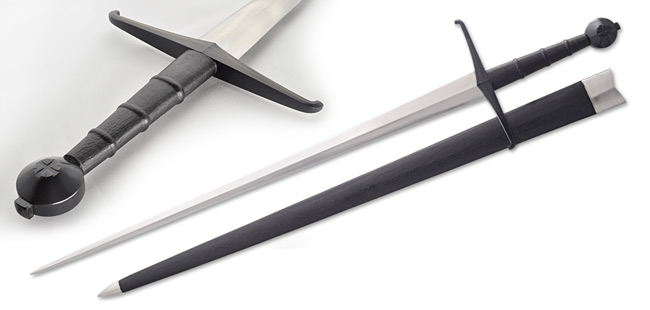
The
distinction between the Type XV and XVa is clear, though the
observant reader will note that many actual swords would seem to fall
midway between. Much of the means of categorization come from the
blade's cross-section and profile taper, and not simply the
proportions of its grip. Many swords might have a general appearance
of the subtype, but because of the shape of the blade, must be
classed as a Type XV.
Both
of these types have been regarded by some as highly specialized
weapons that completely disregard the cut in favor of the thrust. It
could be surmised that their developmental bias went too far into
being single-purposed, but the popularity of these swords for well
over two centuries goes far into convincing us otherwise.
Though
these swords posses a stiff cross-section and reinforced tip, it is
clear that the ability to cut was not entirely tossed aside. These
very same features that aide the thrust also have the effect of
adding strength to the tip-section of the blade, reducing the chance
of breakage to the acutely-pointed tip during a cut.
Every
sword design must weigh the possible scenarios it may face, creating
compromises and picking specifics on which to focus. In this regard,
the Type XV and its subtype both seem to have made far fewer
compromises than others, while still enjoying versatility in their
design. Certainly, this type was not simply effective at its intended
purpose, but devastatingly successful.
Available Reproduction in the Market:
Arms
& Armor has
done a good job at replicating XV.2, shown above, as their model #188
French Medieval Sword. They also have another model, the #086 Duke of
Urbino Sword, replicating an Italian sword located in a private
collection, Circa 1380-1410. The XVa.3 featured above is available as
the #034 Black Prince Sword.
A
replica of sword XV.4 from The
Metropolitan Museum of Art is
available from Del
Tin Armi Antiche as
their model DT2153
15th Century Sword.
They also recreated the XV.5 Monza sword, calling it the DT2150
Sword of Estore Visconti.
Example
XV.6 found in The
Wallace Collection has
been replicated by both Museum
Replicas Limited as
the "Shrewsbury Sword" and by Del Tin as the model
DT5144.
Museum
Replicas also has a Type XV available with a strong central ridge
that they call "The Guingate Sword".
Albion
Armorers makes
a few Type XVa models: The Next
Generation Castellan,
Mercenary, Constable, and Agincourt swords. The Squire
Line Late
15th Century Bastard Sword is also a Type XVa. The Poitiers is a Type
XV.
Ablion Oakeshott Typology
http://www.albion-swords.com/articles/oakeshott-typology.htm
http://www.oakeshott.org/typo.html